Two identical chalets in the same resort can generate very different annual revenues for one simple reason: one charges a fixed rate all year round, while the other adjusts its prices to actual market demand. That gap isn’t luck. It’s dynamic pricing, and it can be managed methodically.
For a short-term rental owner, a price set once at the start of the season can mean a significant loss of income: a fixed rate is almost always too high in the low season, which empties the calendar, and too low in the high season, which leaves money on the table just when guests would be willing to pay more. Dynamic pricing means adjusting the price regularly according to demand, season and booking lead time. It lets you capture the real value of every night.
A case study published by AirDNA illustrates this potential: StayMarquis reports that properties following its dynamic pricing recommendations generated roughly twice as much gross annual revenue as comparable properties that kept fixed rates. While this result is specific to its portfolio, it shows the impact of regularly adjusted pricing.
The principle is simple: the stronger the demand, the higher the price should go; the weaker the demand, the more it should come down to capture bookings that would otherwise go to a better-positioned competitor.
In this article, we set out a 7-step method for setting the right price, then look at the specifics of mountain properties, the promotions to use at each stage of a rental project, and what professional property management actually changes in this equation.
The 7-step method for setting the right price
Setting the right price isn’t about guessing a figure that “sounds right”. It’s a structured process, based on market data and managed over time.
Step 1: Set a realistic base price
The base price is the foundation on which all adjustments are built. It should reflect the real value of your property in your local market, not a rough estimate or your neighbour’s rate copied as is.
To define it, you need to cross-reference several factors:
- the average nightly rate of comparable properties nearby,
- the guest capacity,
- the amenities offered (view, ski access, parking, spa…), and
- the area’s historical occupancy rate.
As PriceLabs points out, a base price that is consistent with the market is the most important pricing lever: it provides a solid foundation for all subsequent adjustments, whether automated or manual.
If you don’t yet have a booking history for your property, several tools can estimate its potential revenue before you even get started. We have reviewed the most reliable ones in a dedicated article: How much can an Airbnb generate? 5 free tools.
Step 2: Study seasonality and local competition
The same property can justify a rate two or three times higher in a school-holiday week than in a quiet one. Mapping the year’s main cycles in advance lets you build a baseline pricing calendar, rather than reacting week by week once the season is under way.
In the mountains, the main cycles of the year are the winter season, the summer season and the quieter seasons of spring and autumn.
The other side of this step, often overlooked, is to regularly check what comparable properties in your area are charging: similar size, equivalent standard, similar proximity to the slopes or the resort centre. A rate may look perfectly justified on paper and still be uncompetitive if several equivalent properties nearby are listed at lower prices for the same dates.
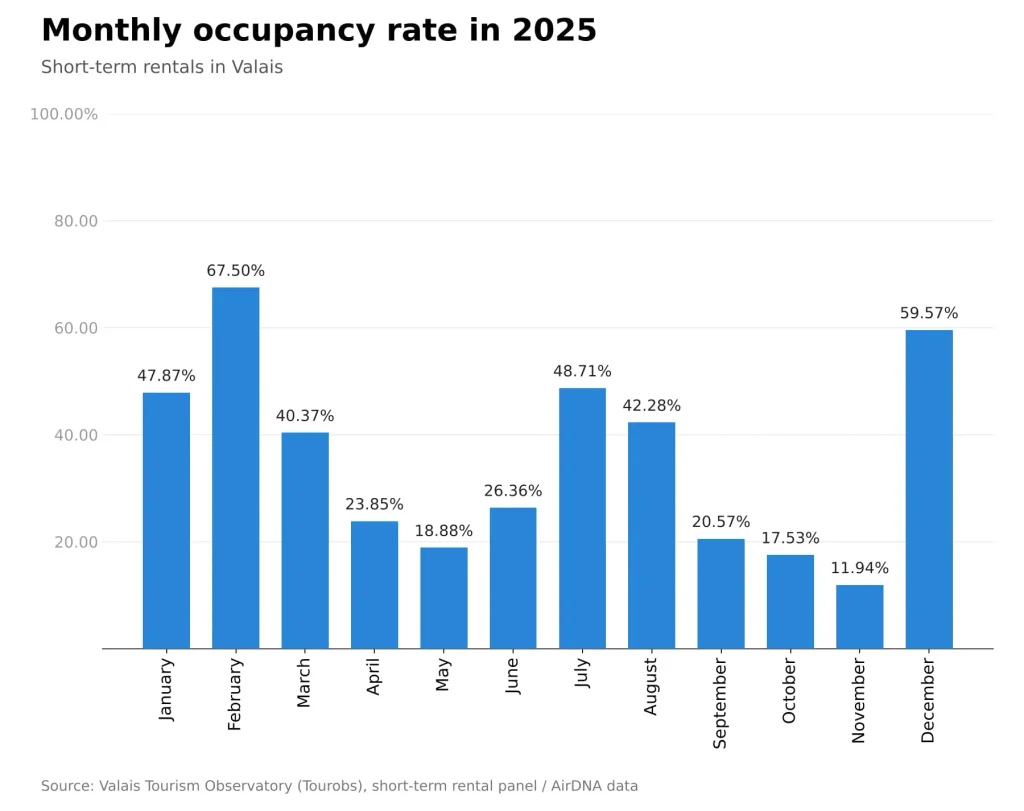
This seasonality is particularly visible in Valais. According to the Valais Tourism Observatory, short-term rentals reached an occupancy rate of 67.5% in February and 42% in August 2025, compared with just 18.8% in May and 11.9% in November. These gaps show how important it is to adapt your rates to shifts in demand throughout the year.
Step 3: Adjust according to booking lead time
When a booking is made says a lot about how much a guest is willing to pay. A booking made several months in advance can, depending on expected demand, justify a higher rate: the guest is looking to secure a sought-after property.
Conversely, a last-minute booking a few days before arrival sometimes needs a more attractive rate to avoid an empty night, especially in the low season or midweek.
The logic also works the other way: if bookings for a given period come in faster than expected, it makes sense to raise the prices of the remaining dates rather than automatically discounting them.
Step 4: Make the most of demand peaks
Beyond the main seasonal cycles mapped in step 2, one-off events create short and sometimes less predictable windows of demand: a sports competition, a festival, the official opening or closing of the ski season, or even a heavy snowfall that triggers last-minute bookings.
These windows, narrower than a full season, call for close monitoring rather than once-a-year planning: these are precisely the moments when the price should reflect the property’s real scarcity, rather than stay aligned with an annual average that smooths out these peaks.
A ski resort’s events calendar, usually published several months in advance by the local tourist office, is well worth checking regularly.

Step 5: Adapt the rate to the listing platform
A property doesn’t necessarily benefit from showing exactly the same price on Airbnb, Booking.com and Vrbo. The platforms have different fee structures, different guest profiles and different weight in search algorithms.
In practice, a rate can be adjusted upwards on a platform that charges a higher commission, to protect your net income once fees are deducted.
A slightly higher price on a given platform can also help steer demand towards a more premium, less price-sensitive clientele.
It’s a fine-tuning lever, but it has a real impact on net returns when a property is listed on several channels at once.
Step 6: Use a dynamic pricing tool
Adjusting prices manually, night by night, across several platforms quickly becomes impossible to sustain. Specialised tools continuously analyse demand, competition and booking trends to recommend an optimal rate every day.
Feedback compiled by Your.Rentals on PriceLabs shows that this type of algorithm takes into account local supply and demand, seasonal trends and booking lead time to calculate the most relevant price at any given moment.
This kind of automation is hard to replicate manually, especially for an owner managing their property alongside a full-time job.
Step 7: Track performance and adjust continuously
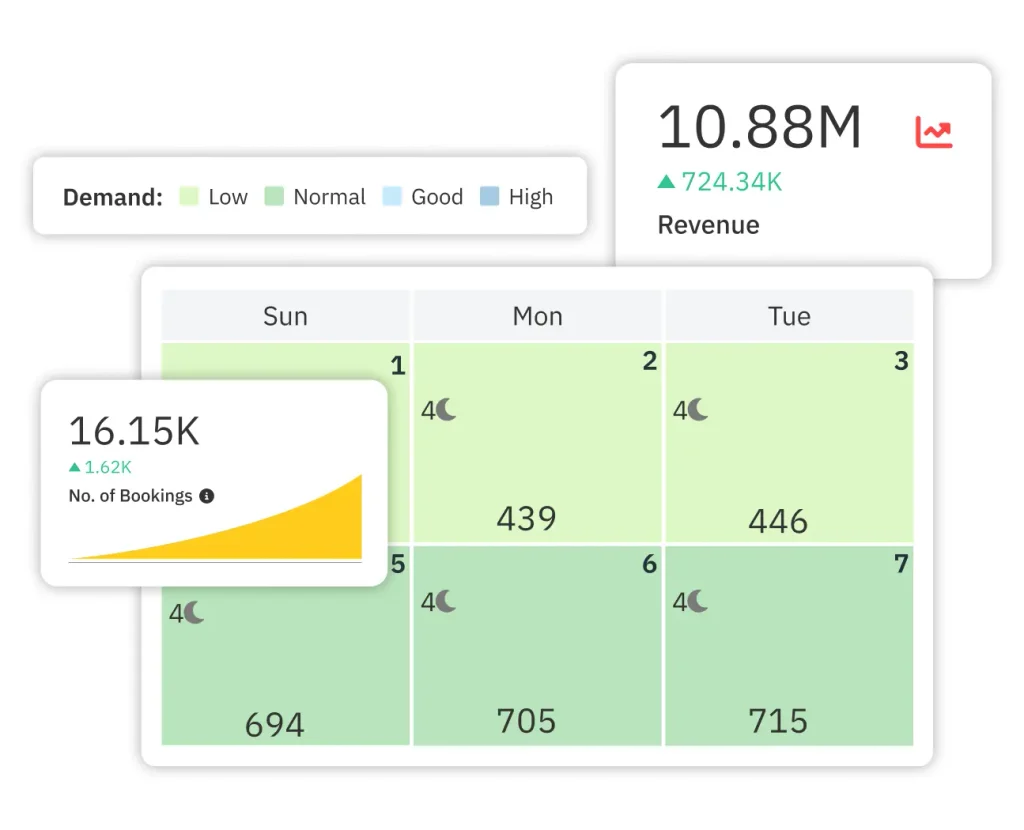
Dynamic pricing is never set in stone. A price set today must be reviewed regularly in light of the bookings actually received, the occupancy achieved and changes in the competition.
A pricing strategy is managed like a dashboard, not like a decision taken once a year.
Mountain properties: why pricing is even more strategic
In the mountains, dynamic pricing takes on a particular dimension.
The Swiss Alps generally enjoy two distinct high seasons: winter, driven by winter sports, and summer, driven by outdoor activities and the search for cooler air.
This dual seasonality shapes how rates should be managed over the year:
- Significantly higher rates during winter and summer school-holiday weeks,
- Longer stays in the high season, making it possible to get week-long bookings and limit turnovers,
- Low-season weekends where a more flexible rate helps attract last-minute guests,
- Shoulder seasons that resorts are increasingly developing to spread visitor numbers across the year.
This two-high-season structure is a real advantage over single-season destinations, but it also calls for finer pricing: a rate that works in February should never simply be copied over to July.
To learn more about the factors that drive profitability in the mountains, read our article The 8 factors that determine the profitability of a short-term rental.

Promotions: a lever to use at the right time, not all the time
Dynamic pricing isn’t just about raising or lowering a displayed price. One-off promotions also play a role, provided they are used with judgement and at the right stage of the rental project.
When a property is first launched, with no reviews or booking history yet, an introductory promotion helps secure the first nights and quickly builds up a base of positive reviews. These early reviews help strengthen the listing’s credibility with future guests.
Once the property is established, the logic changes: in the high season, targeted discounts on longer stays (a week or more) often secure more stable bookings, reduce guest turnover and therefore cleaning costs between stays, while remaining attractive against competing properties offering shorter stays.
Finally, some weekends simply don’t sell despite good overall positioning: rather than leaving those dates empty, a promotion targeted at that specific slot is often more profitable than an unsold night.
The key is never to apply a promotion across the whole calendar: it should serve a specific purpose (launching, building loyalty or filling a gap) and not become a permanent reflex that drags all rates down.
The role of professional management in optimising rates
Setting up effective dynamic pricing takes time, the right tools and regular monitoring, three resources few owners can commit alongside a job or while living far from their property. This is exactly where professional property management makes the difference.
At Agence Monreve, rate adjustment is part of the day-to-day management of every property:
- Analysis of local seasonality,
- Monitoring of the competition,
- Adapting to events in the region, and
- Balancing early bookings against last-minute requests.
The goal is always the same: to sell every night at a price as close as possible to its real market value, without you having to watch your booking calendars every day. To find out more about our approach, discover our turnkey solution.
Conclusion: effective pricing requires continuous management
Base price, seasonality, booking lead times, platforms, targeted promotions: on pricing alone, the list of parameters to track is already long for a single owner. And pricing is only one of the many skills a well-managed short-term rental requires.
Full management also involves proactive communication with guests, coordinating cleaning and maintenance, managing reviews and complying with local regulations.
It’s this accumulation of technical tasks, each manageable on its own but heavy once combined, that is leading a growing number of owners to entrust their property to a professional concierge service rather than handle everything themselves.
To understand what delegated management changes day to day, read our article Airbnb concierge: 6 concrete reasons to use one.
If you’d like to assess what your property could actually earn with optimised pricing and professional management, contact Agence Monreve: we’ll provide a personalised estimate of your potential rental income.
Estimez le potentiel de votre chalet gratuitement
Nos experts analysent votre bien, son emplacement et le marché local pour vous fournir une estimation précise et sans engagement de vos revenus locatifs potentiels — sous 24h.
Contactez-nousÀ retenir
1. La photographie professionnelle est cruciale
Les voyageurs font défiler des dizaines d'annonces. Seule une photo exceptionnelle arrête le pouce. C'est la différence entre être vu et être ignoré.
2. La tarification dynamique maximise les revenus
Fixer un tarif unique, c'est laisser jusqu'à 35% de revenus potentiels sur la table. Les prix doivent s'adapter à la demande et à la saisonnalité.
3. Gestion clé en main = Tranquillité d'esprit
Confier son bien à une agence spécialisée permet de déléguer la logistique tout en gardant le contrôle via un tableau de bord dédié.

Originaire du Valais et fort de plus de dix ans d’expérience en architecture, Tim sait révéler le potentiel de chaque espace pour le sublimer.